
Shakespeare & Company
About Us
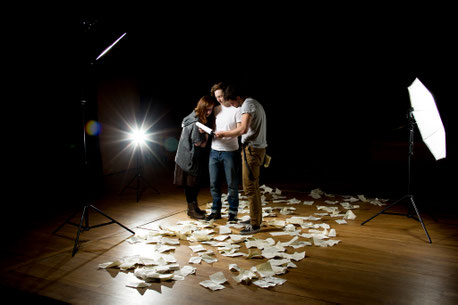
Shakespeare & Company is an English language student theatre company at the University of Regensburg. Founded in 2013 by our director Susanne Guertner, we have since staged eight productions of Shakespeare's plays at the Theater an der Uni Regensburg. Over more than 10 years, we have tackled comedy (As You Like It, Twelfth Night, A Midsummer Night's Dream), tragedy (Hamlet, awarded with the Martin Lehnert prize by the German Shakespeare Society), and romance (The Tempest, The Winter's Tale, Cymbeline).
Texts
Careful reading of Shakespeare's original text is the foundation for each of our productions. Because we are comprised of largely non-native speakers and perform these 400+ year old texts for largely non-native speakers, extra care has to go into the preparation and settling on the final performance script is usually a collaborative process involving everyone over the course of rehearsals. While we make careful cuts to the text, we generally do not modernise words or make rewrites. Our productions use modern pronunciation.

Casting
Shakespeare's plays are fundamentally ensemble pieces, and we strive to honour that tradition by approaching casting as a process for finding matching groups of actors whose dramatic, comedic, or romantic chemistry can most effectively communicate the relevant scenes. Our casting usually takes place over several weeks of workshops to make sure all characters are well matched and balanced.
Because finding the best matches of characters and actors is such a high priority for us, we have from the beginning practiced gender- and colour-blind casting: We have had, to name but a few, a female actor portraying Prospero, or a male actor portraying Olivia. In part, this is a reflection of the complex gender politics of Elizabethan/Jacobean theatre, which was performed by all-male theatre companies – one of the reasons why gender based confusion is such a recurring theme in Shakespeare, to which we thus gleefully add. Our casting, however, also reflects that we do not produce strictly historicising stagings that seek to represent some imagined historic situation. Rather, we want to treat our plays as spaces in which both actors and audience encounter a historic text in a lively and engaging manner. The actors' identities take a back seat while the text is at the centre and after a few moments, no one bats an eye that it is a male voice that speaks the line "think me so much a sister as a wife". If the audience registers, that it is a female performer who takes on the part originally written for a boy to utter the lines of Viola to say, in the disguise of the boy Cesario: "And yet a barful strife/ Whoe'er I woo myself would be his wife", we hope that it enhance the appreciation of the play's intricacy, rather than distract from it.
Music
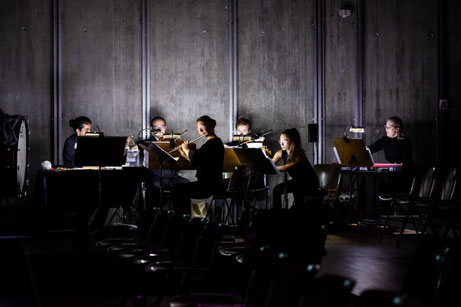
From the beginning, live music has been a core feature of our productions. Our faithful musical director Rolli Bohnes has written and rehearsed hours of original music, performed by varying ensembles between 2 and 5 in size. Over the years we've had it all: folksy, jazzy, classical, atonal, aleatoric, minimal, performed on string and wind instruments just as much as on guitar and bass, steel crossbars and, in one memorable instance, a celesta. Where the play demands it, we of course also sing and dance on stage, with our long time group member Eva Hackl taking on the role of music coach for our actors.

Stage
Traditionally, Shakespeare's plays are notoriously stingy with stage directions, props or decorations – a result of the Elizabethan thrust stage layout, which featured no curtains that could be lowered for elaborate scene changes and anything you carried on stage you had to carry off again at the end of the scene. Our stage designs reflect that tradition, largely eschewing elaborate decorations in favour of static, architecturally inspired and undecorated stage buildings that remain in place over the entire performance and provide a blank canvas on which the human interactions at the core of each play can unfold. Typically, this relatively bare stage will feature an accent piece – a tree, a set of mirrors, a chequerboard floor, a tree again – that serves to highlight a core theme of the production.
While our stages thus don't feature many decorations or scene changes, we take great care to utilise the lighting equipment of the theatre to its fullest extent. In each production, the carefully selected and painstakingly tuned lighting holds a key position in the visual story telling.
Thanks
No single theatre production can happen without the help of many, let alone eight. We are deeply grateful for the continued support our group has received from many unwavering supporters.
First to name here is the Studierendenwerk Niederbayern/Oberpfalz which operates the Theater an der Uni. This performance space, with its incredible equipment and, most importantly, its dedicated and enthusiastic technical staff, is the foundation of all our productions.
The City of Regensburg has liberally funded several of our plays, which has allowed us to lastingly broaden the scope of our productions.
The English department at the University of Regensburg has had our back since the beginning and has supported us with offering introductory talks for several of our plays.
Local breweries Brauerei Bischofshof and Schlossbrauerei Eichhofen have gracefully donated to help us supply our audience with refreshments over all of our productions.