

Twelfth Night
by William Shakespeare
Theater an der Uni
12–17 January 2026
Explore our image gallery, see some behind the scenes photos, or read more about our production here.

About this Production
A Note on Genre
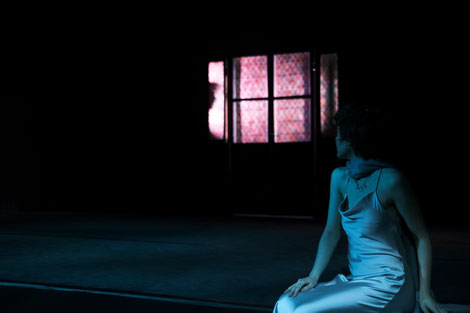
First performed in 1602, Twelfth Night is one of Shakespeare's last comedies. While the play still reads as comedic to modern audiences, it nonetheless lingers on themes of loss, melancholia, and unrequited love. These unresolved threads that run through the play and continue up to the otherwise happy ending already foreshadow Shakespeare's later experimentation with genre in the "Problem Plays" and romances. Fundamentally, the Illyria of Twelfth Night presents as a melancholic place, overburdened with mourning: After the shipwreck, the twins Sebastian and Viola believe each other to be dead, while the household of Olivia is in mourning for the Lady's father and brother. The play's closest thematic relatives in tragedy appear to be Hamlet (ca. 1600) and King Lear (ca. 1605), where the deaths of fathers and siblings, or the fool's cryptic songs take their respective plays into much darker territory.
About the Casting
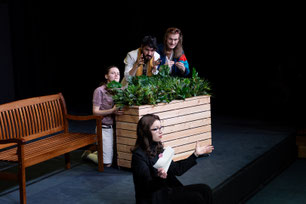
Twelfth Night is essentially interested in gender performance. Again and again, the play uses its crossdressing heroine and the various relationships she enters to reflect on and interrogate the role of gender in romance, attachment, and friendship. At the same time, the Early Modern performance practice of an all-male cast invites the use of gender and the elements of its construction as a plot device and a source of self-reflective comedy. Taking our cue from this original performance practice, we see the gender of our actors as non-essential to their portrayal of a character, which is reflected in our long-standing tradition of gender-blind casting.
In casting Twelfth Night, we initially sought to find pairings and groups of actors that would best suit each other's dramatic, comedic, or romantic energy. Once these groups were established, we went one step further and explored different gendered presentations for different characters. This approach has proven interesting for two reasons: For one, it highlights that, in a modern setting, the social roles of characters are less limited by gender. At the same time, free play with it can recover or reinterpret nuances of the text and character dynamics that are not as easily accessible to a modern audience. For example, the difference in social status between the steward Malvolio and the Countess Olivia – a central dynamic of the text – reads differently in a modern setting. In this production, we found that experimenting with the gender presentation of certain characters helped us shine a new light on some of the themes of the original text that can easily get lost in a modern production. We see our work with the play as a way of entering into a dialogue with the original text. Consequently, we have decided to retain original names and pronouns, finding that it helps to keep in view both this historical textual scaffolding and what happens to the text when it is rendered strange and unfamiliar through reinterpretation.

About the Music
If music be the food of love... Music is an essential part of Twelfth Night: Not only is it the Shakespeare play featuring the most songs, it also makes a point of invoking music as a focal point of characters' emotions throughout the play. As was the case for our past productions, Rolli Bohnes has created original music. Taking the prominent songs, and the final The Wind and the Rain in particular, as a starting point, the music follows the text in blending humorous elements with notes of longing and loss. A gentle use of musical patterns, which the musicians are free to combine in an improvisational manner, further establishes them as involved contributors to the play as it unfolds, a characteristic that is underscored by the fact that the line between music and acting gets blurred quite bit at points during this production.
Cast
Orsino: Janosch Umbreit
Curio: Simon* Hensel
Valentine: Felix Schießl
Viola: Elisabeth Blob
Captain: Jochen Petzold
Sir Toby: Nicolas Symeou
Maria: Sandra Weiß
Sir Andrew: Nele Heaslip
Feste: Eva Hackl
Olivia: Elena Bogner
Malvolio: Chris Gurău
Antonio: Lukas Müller
Sebastian: Sarah Limmer
Fabian: Joffrey Ziell
Officer 1: Felix Schießl
Officer 2: Franziska Kramler
Priest: Jochen Petzold
Creative Team
Director: Susanne Gürtner
Musical Director: Rolli Bohnes
Light: Lea Fuchs & Samuel Arnold
Costumes: Chris Gurău, Elisabeth Blob, Elena Bogner, Susanne Gürtner
Stage Building and Props: Elena Bogner, Janosch Umbreit, Eva Hackl, Chris Gurău
Stage Design: Susanne Gürtner, Elena Bogner
Artwork: Nicolas Symeou
Photography: Alex Urban, Susanne Gürtner
Band
Piano: Leonard Prokisch
Bass: Simon* Hensel
Drums: Samuel Keck
Violin: Kristina Rau
Clarinet: Lara Sturm
Bass Clarinet: Clara Schwenke